
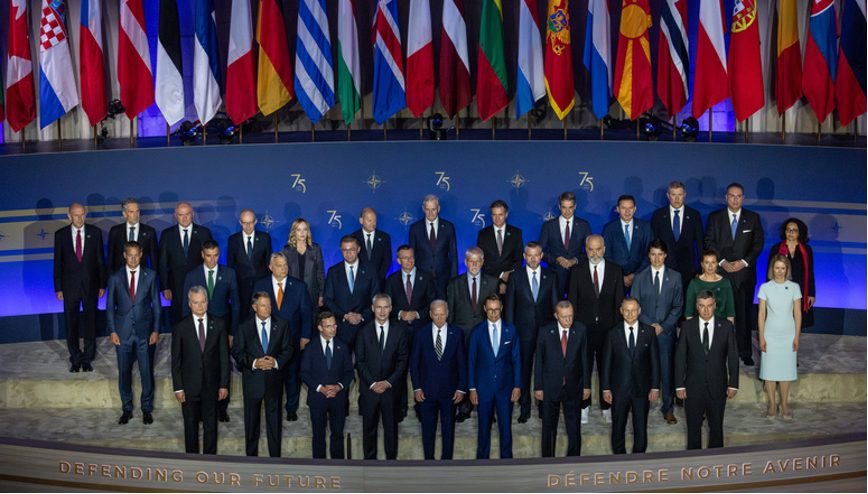
Leaders at the Washington Summit. NATO IMG [10 July 2024]
This policy brief summarises the 75th NATO Summit and addresses NATO’s missed opportunity to respond to major questions surrounding the US presidential election – What a potential presidential shift would mean for the future of transatlantic relations should Trump fall back into power.
On July 10-11, world leaders gathered for NATO’s Washington Summit, marking the historic 75th Anniversary of the Alliance. On July 10th, the Washington Summit Declaration was released, a consensus document setting forth what the Alliance stands for.
While the declaration sets out the status of the Alliance, several questions and missed opportunities to address its challenges remain unresolved, one of them being the future of US-NATO relations in the aftermath of the coming presidential election. The potential presidential shift was not addressed during the summit. Rather, the Summit was Trump-proofing the Alliance, emphasising the importance of continued transatlantic cooperation.
But before digging deeper, let’s summarise the Summit.
Five Key Takeaways
The Summit declaration can be summarised in five main points: continued support for Ukraine and commitment to strengthening deterrence and defence within the Alliance, followed by efforts to strengthen the northern and southern flank, and increased global cooperation in the Asia-Pacific.Ukraine. NATO strengthened support to Ukraine, defining its pathway toward NATO as “irreversible,” marking Ukraine’s bridge to NATO membership. Although not declaring when the country will be formally invited to the Alliance, the declaration outlined a pledge of long-term assistance to Ukraine, laying out military support with new packages including Patriot batteries and other sophisticated defence systems such as Abrams tanks, Bradley Fighting Vehicles, and F-16 fighter jets. This dedicated support affirmed NATO’s continued support to Ukraine, sending a strong signal to Moscow about its broader mission to defeat Russian aggression.
Deterrence and Defence
Leaders agreed to advance NATO’s command structure and put NATO’s new generation of defence plans into practice, strengthening its deterrence and defence capabilities, spanning over all domains. A modernised NATO will not only be able to deter threats more efficiently but also mark an active alliance. It is yet to be questioned whether the Allies’ defence expenditure goal is meeting this ambition. A modernised NATO will need funding and support from all its members.
The Northern Flank
The summit demonstrated NATO’s commitment to strengthening the northern flank, taking “full advantage of the accession of Finland and Sweden.” With Finland and Sweden as new members, the summit was historical in terms of inaugurating the countries as members of the alliance, marking a strategic shift towards Northen strength. It is clear there will be a more active NATO in the north.
The Southern Flank
Members agreed to reinforce the dialogue with the southern neighbourhood, with an emphasis on partnerships in the Mediterranean and the Persian Gulf, and the role of NATO’s hub for the South in Naples. Despite this, NATO did not address deterrence against Chinese and Russian disinformation and malign investment campaigns in South America.
Asia-Pacific 4 (AP4)
China’s increased prominence in NATO statements has led the Alliance to re-evaluate its partnerships in the Indo-Pacific region. The Summit welcomed the continued contribution of Asia-Pacific partners (Australia, New Zealand, Japan, and South Korea) in NATO summit discussions, stating that China cannot enable the largest conflict in Europe in recent history without this negatively impacting their interests and reputation.
With these key points emphasised during the summit, there is no doubt that NATO is facing pressure and are taking active steps to respond to its geopolitical challenges. Although systemic pressure was addressed in the Declaration, the Summit falls short of answering pivotal questions such as when Ukraine will join NATO, the consequences of member countries not meeting the GDP target, deterring China and Russia in South America, and extended Asia-Pacific cooperation. It also completely misses the major question about the future of transatlantic cooperation – the Trump-question.
Will Trump return as President?
The Trump-Question
Trump was the proverbial elephant in the room at the summit. The lingering questions surrounded whether Trump would win the election and what would happen should he return to power.
Will Trump win the election?
Although the election is still 3 months away, we can expect a presidential shift. While the polls are currently biding better for Harris, Trump still might win. Per now, election polls show that Harris has caught up with Trump with 49.4% chance of winning the presidency and a 3% lead based on 126 polls (The Hill, 19th August 2:29 EDT). However, they still might shift again.
If Trump were to return as President, what would happen to US-NATO relations?
The Future of US-NATO Relations
With a history of NATO criticism, there is much debate on Trump’s relation to the Alliance: Will he leave NATO? What are the challenges Trump would pose to transatlantic relations as President? Is Trump-proofing enough to keep the US in the Alliance?
Will Trump pull out of NATO?
No, it is unlikely that the US will end NATO membership. According to former Trump national security officials and defence experts, Trump will continue his attempt to transform the Alliance, expecting that European countries drastically increase their spending on NATO, as well as undertaking a ‘radical reorientation’. The shift would involve a downsize of their role, stepping back instead of being the primary provider of combat power in Europe.
Furthermore, if the US were to quit, NATO would not end. As General Secretary Stoltenberg said: the US would stay in NATO because the alliance’s members represented 50% of the world’s “military might”. If the US leaves it would stand alone and represent just 25% of that military capability.
Is Trump-proofing enough?
No. As President, Trump is likely to keep pushing for a security architecture more to his liking. In his mission, four major challenges would be affecting US-NATO relations.
Ukraine
Trump has reiterated that he would end US aid to Ukraine. At a campaign rally in Detroit in June, Trump criticised Ukrainian President Volodymyr Zelenskyy, calling him “the greatest salesman of all time” for Kyiv’s push to secure US support in its effort to defend Ukraine against Russian aggression more than three years after Moscow’s all-out invasion. If the US quits its support to Ukraine, there will be a greater financial burden on Europe and pressure on their industrial capacity to meet Ukraine’s needs.
Allied Relations
A part of Trump’s emerging game plan, is a two-tier NATO system, meaning that the US will not protect members who do not meet the 2% GDP guideline. At a rally in Conway, South Carolina in February, Trump appeared to invite a Russian attack against NATO deadbeats, saying he’d “encourage” the Russians to “do whatever the hell they want” with member countries that have not yet met the defence spending target. This could be seen to be in defiance of Article 5 of the treaty, which obliges every member to take “such action it deems necessary” to assist whoever is attacked. Transatlantic relations will become challenging should Trump continue his effort to undermine NATO principles.
Greyzones in NATO Bill
Although the US Congress has passed legislation to ensure that no president can pull out of NATO without their approval, it is not enough. A president could reduce the number of exercises Americans take part in with NATO allies, further reduce troop presence in Europe, withhold payments to the NATO infrastructure or cut down on the US military budget. In other words, if Trump wins the election and seeks to reduce American military participation, he could, in theory, recall the NATO Supreme Allied Commander Europe. This could be a major challenge for future transatlantic collective defence and security.
Change of NATO Leadership
The newly elected Secretary General Mark Rutte has a reputation for being agile with Trump. Whether he will be able to withstand Trump’s outbursts towards the Alliance, as well as reining him back into NATO will certainly challenge NATO’s diplomatic skills.
Summary
To summarise, the future of US-NATO relations remains under debate. Although the Declaration set out the status of the Alliance and addressed geopolitical pressure in the North, South and East, it missed out on the opportunity to address the Trump-question. Although election polls have shifted in favour of the Democrats, they might yet shift again. And should Trump become president, he will put pressure on US-NATO relations.
I end this brief by reminding the reader that although transatlantic relations would face pressure following a potential presidential shift, we must first and foremost remember that the greatest threat to NATO is not Trump, it is Putin.
Denne månedens innsikt er skrevet av Sofie Homb. Innsikten ble skrevet 21. juli og ble sist oppdatert 21. august. Synspunktene uttrykt i artikkelen er skribentens egne og representerer ikke nødvendigvis YATA Norges meninger. Har du lyst til å skrive månedens innsikt? Send e-post til innsikt@yata.no
Reference List
Atlantic Council. (2024). Our experts read between the lines of NATO’s Washington summit communiqué. Available at https://www.atlanticcouncil.org/blogs/new-atlanticist/experts-react/our-experts-read-between-the-lines-of-natos-washington-summit-communique/ [Retrieved 16.07.2024].
Dorman, A. (2024). As Trump threatens NATO, is it time for Europe to get its act together? Chatham House, 13 February. Available at https://www.chathamhouse.org/2024/02/trump-threatens-nato-it-time-europe-get-its-act-together [Retrieved 18.07.2024].
Government Offices of Sweden. (2024). Sweden has taken part in NATO Summit for the first time as full member. Government Offices of Sweden, 13 July 2024 [Press Release]. Available at https://www.government.se/articles/2024/07/sweden-has-taken-part-in-nato-summit-for-the-first-time-as-full-member/ [Retrieved 18.07.2024].
Hirsh, M. (2024). Trump’s Plan for NATO Is Emerging. Politico, 7 July. Available at https://www.politico.com/news/magazine/2024/07/02/nato-second-trump-term-00164517#:~:text=In%20truth%2C%20Trump%20would%20be,a%20second%20Trump%20term%20intact. [Retrieved 16.07.2024].
Lesser, I. (2024). The NATO Washington Summit: Look Carefully for the Southern Strategy. German Marshall Fund, 15 July. Available at https://www.gmfus.org/news/nato-washington-summit-look-carefully-southern-strategy [Retrieved 18.07.2024].
Monaghan, S. (2024). Beyond “Trump-Proofing”: NATO’s Real Adversaries. CSIS (Center for Strategic & International Studies), 18 July. Available at https://www.csis.org/analysis/beyond-trump-proofing-natos-real-adversaries [Retrieved 20.07.2024].
Moyer, J. C. (2024). NATO’s 75th Anniversary Summit: Standing the Test of Time. Wilson Centre, 11 July. Available at https://www.wilsoncenter.org/article/natos-75th-anniversary-summit-standing-test-time [Retrieved 18.07.2024].
NATO. (2024). Washington Summit Declaration issued by the NATO Heads of State and Government participating in the meeting of the North Atlantic Council in Washington, D.C. 10 July 2024 [Press Release]. Available at https://www.nato.int/cps/en/natohq/official_texts_227678.htm?utm_medium=email&utm_campaign=NATO%20Update%20-%20week%2028&utm_content=NATO%20Update%20-%20week%2028+CID_74962d0d849bd8782738e57258e9e03b&utm_source=Email%20marketing%20software&utm_term=Read%20more [Retrieved 16.07.2024].
O’Carroll, L. (2024). ‘Stoltenberg assures EU that Nato would survive second Trump presidency’. The Guardian, 18 July. Available at https://www.theguardian.com/world/article/2024/jul/18/stoltenberg-assures-eu-that-nato-would-survive-second-trump-presidency [Retrieved 20.07.2024].
RAND. (2024). NATO Summit in Washington: RAND Experts Weigh In. RAND Corporation, 8 July. Available at https://www.rand.org/pubs/commentary/2024/07/nato-summit-in-washington-rand-experts-weigh-in.html [Retrieved 18.07.2024].
Rintakumpu, F., Arts, S., & Nash, P. (2024). The NATO Washington Summit: Nordic Allies Emerge Stronger. German Marshall Fund, 12 July. Available at https://www.gmfus.org/news/nato-washington-summit-nordic-allies-emerge-stronger [Retrieved 18.07.2024].
Sullivan, K. (2024). ‘Trump says he would encourage Russia to ‘do whatever the hell they want’ to any NATO country that doesn’t pay enough’. CNN, 11 February. Available at https://edition.cnn.com/2024/02/10/politics/trump-russia-nato/index.html [Retrieved 20.07.2024].
Temnycky, M. (2024). ‘What Happened at the 2024 NATO Summit?’ Newsweek, 18 July. Available at https://www.newsweek.com/what-happened-2024-nato-summit-opinion-1927189 [Retrieved 18.07.2024].
The Hill. (2024). Decision Desk HQ Decision Desk HQ and The Hill’s ultimate hub for polls, predictions, and election results. Available at https://elections2024.thehill.com/forecast/2024/president/ [Retrieved 22.07.2024 and 21.08.24].
The White House. (2024). The 2024 NATO Summit in Washington. The White House, Briefing Room, 10 July [Fact Sheet]. Available at https://www.whitehouse.gov/briefing-room/statements-releases/2024/07/10/fact-sheet-the-2024-nato-summit-in-washington/ [Retrieved 18.07.2024].
Wolf, Z. B. (2024). ‘Congress acted to protect NATO. But it might not be enough to stop Trump’. CNN, 13 February 2024. Available at https://edition.cnn.com/2024/02/13/politics/congress-trump-nato-what-matters/index.html [Retrieved 20.07.2024].
